
Helping Agapelife Church Global turn repeated website rejections into a successful Google nonprofit approval
Agapelife Church Global was a registered Canadian charity with genuine community programmes, an active mission, and the documentation needed to establish its nonprofit status.
But approval was not coming through.
Across multiple review rounds, Google continued to flag the website for issues around speed, navigation, content depth, calls to action, nonprofit visibility, and clarity around the organisation’s mission and activities.
We worked through the problem systematically: auditing what Google was seeing, restructuring the website, strengthening programme and organisational information, improving technical performance, removing credibility gaps, and making the organisation easier to understand and verify.
After multiple rounds of improvements and resubmissions, Agapelife Church Global was approved.
APPROVED
after multiple review rounds
FULL WEBSITE OVERHAUL
for approval readiness
CLEAR CHARITY STATUS
prominently displayed
STRONGER PROGRAM EVIDENCE
across the website
Agapelife Church Global
Agapelife Church Global is a registered Canadian charity based in Regina, Saskatchewan.
Alongside its faith-based ministry, the organisation runs community-focused programmes supporting families, students, youth and newcomers. Its work includes poverty-relief initiatives, educational support, youth mentorship, community meals, newcomer assistance, prayer gatherings and fellowship programmes.
The organisation is registered in Canada under Charitable Registration Number 759065352RR0001 and operates from 1053 Winnipeg Street, Regina, Saskatchewan.
The problem was not that the organisation lacked a real mission or charitable status.
The challenge was making the website communicate that legitimacy, activity and impact clearly enough for Google’s review process.
A legitimate charity that the website wasn’t fully proving
When we first reviewed the website, Agapelife already had many of the fundamentals Google would expect from a genuine nonprofit organisation.
But those fundamentals were difficult to verify from the website itself.
Several connected issues were weakening the application.
The nonprofit identity wasn’t prominent enough
Agapelife’s charitable status existed, but the website did not make it immediately clear enough who the organisation was, where it operated, what it did, and how its charitable activities connected to its mission.
For an approval reviewer arriving without context, too much had to be inferred.
Important pages were incomplete or broken
Pages such as Events and Sermons were empty, incomplete or not functioning as expected.
Some navigation elements also led to pages that did not provide enough useful information.
Even when the organisation itself was legitimate, unfinished website sections could make the overall site appear incomplete.
The mission needed evidence behind it
The website spoke about the church and its beliefs, but approval required more than broad mission statements.
The organisation needed clearer information about actual programmes, who those programmes served, recent activities, community outreach and what participation looked like in practice.
Technical issues were affecting the experience
Mobile speed and responsiveness were recurring concerns.
Google’s later rejection specifically called for the website to load quickly and have clear navigation, alongside substantial current content and clear calls to action.
This meant the problem could not be solved through copy changes alone.
Trust signals needed strengthening
Contact information, charity details, programme evidence, organisational transparency, donation information and policy pages all needed to work together.
There were also issues such as inconsistent information, repeated or overly generic imagery, limited leadership information and areas where donation-related content was stronger than evidence of the actual charitable work.
The website needed to feel like the public home of an operating charity, rather than simply a donation or church information page.
Treat the rejection as a diagnostic, not just a resubmission
Rather than repeatedly submitting the same website and hoping for a different outcome, we treated each rejection as evidence.
We compared Google’s feedback against the website, identified what a reviewer could not easily understand or verify, and rebuilt the experience around those gaps.
Audit the approval barrier
We started with a full website review focused specifically on nonprofit approval readiness. That meant checking more than design.
We reviewed:
- nonprofit and charity identification
- mission clarity
- programme descriptions
- real-world activity evidence
- navigation
- broken and empty pages
- calls to action
- donation experience
- organisational contact details
- policy and transparency information
- mobile usability
- page speed
- images and content credibility
The early conclusion was simple: Agapelife’s underlying organisation was credible, but the website was not yet communicating that credibility strongly enough.
Make the organisation immediately understandable
We strengthened the website’s core positioning so a new visitor could quickly answer:
- Who is Agapelife?
- Is it a registered charity?
- Where does it operate?
- Who does it serve?
- What does it actually do?
The homepage was rewritten around a clearer introduction:
“Transforming Lives Through the Love of God.”
Supporting content then identified Agapelife as a registered charity in Regina and explained its work across faith-based programmes, community outreach, educational support and assistance for families, students and newcomers.
Turn broad claims into identifiable programmes
We expanded the website so the mission was supported by specific, understandable activities.
Programme information was developed around initiatives including:
- Dinner With Pastor
- Christmas 200 Families
- Prophetic Prayer Conference
- Student Learning & Support Program
- Teen Empowerment Program
- Newcomer Settlement Education & Support Program
We also clarified the organisation’s ministry and community work across children and youth, prayer, community outreach, worship, mentorship and practical assistance.
This shifted the website from simply saying what Agapelife believes to showing what Agapelife does.
Show who the organisation serves
A dedicated Who We Serve structure was introduced to make the beneficiaries of Agapelife’s work easier to understand.
This included:
- families
- students and youth
- newcomers
- individuals experiencing challenges
The change helped connect individual programmes back to actual community needs.
Add current evidence of activity
One of the biggest gaps was proving that the organisation was actively operating.
We strengthened the site with programme and community updates, dates, activity descriptions and genuine organisational imagery where available.
Examples included community outreach activities, youth musical training and family gatherings.
Where sections did not have meaningful content, the priority was to improve, populate or remove them rather than leave obviously incomplete pages live.
Improve trust and transparency
We strengthened the organisational signals throughout the website.
This included clearer:
- charity registration details
- physical address
- email and phone information
- donation information
- privacy information
- terms of use
- donation policy
- organisational language
- footer information
We were also careful not to manufacture transparency.
For example, where financial documentation was not intended for public website publication, the answer was not to invent reports or claims. Instead, the website was structured to accurately state Agapelife’s registered-charity status and reporting responsibilities.
Fix the technical and usability layer
One of the biggest gaps was proving that the organisation was actively operating.
We strengthened the site with programme and community updates, dates, activity descriptions and genuine organisational imagery where available.
Examples included community outreach activities, youth musical training and family gatherings.
Where sections did not have meaningful content, the priority was to improve, populate or remove them rather than leave obviously incomplete pages live.
Review, resubmit, learn, repeat
The project required more than one correction cycle.
Each rejection was reviewed against the current website rather than treated as a generic refusal.
One of the later Google responses specifically asked Agapelife to:
Change the website to load quickly and have clear navigation, include substantial and up-to-date content and calls to action, prominently display nonprofit status, and clearly describe the organisation’s mission and activities.
Those requirements became the checklist for the next iteration. We continued fixing the gaps until the site and organisational presentation met the approval standard.
The final result: Agapelife Church Global was approved.
What changed and why it mattered
Approval Status
- Rejected during repeated reviews
- Approved
Nonprofit Identity
- Charity status not prominent enough
- Registered charity status and registration number clearly displayed
Mission
- Broad church and faith messaging
- Clear explanation of mission, community role and charitable activities
Programs
- Limited detail around actual activities
- Specific programmes with beneficiaries and purpose explained
Activity Evidence
- Limited current proof of work
- Community updates, programme details and real activity evidence added
Navigation
- Empty, incomplete or unclear destinations
- Cleaner navigation focused on useful organisational content
Website Content
- Thin or incomplete sections
- Substantial content across mission, ministries, programmes and community work
Calls to Action
- Limited or inconsistent
- Clear paths to explore programmes, volunteer, participate and donate
Technical Experience
- Mobile speed and usability concerns
- Performance and mobile experience improved for approval readiness
Trust Signals
- Important organisational information fragmented
- Charity registration, address, contact details and policies made easier to verify
Imagery
- Repetition / generic imagery concerns
- Greater focus on relevant programme and organisational imagery
Website Structure
- Important information difficult to verify quickly
- Website organised around who Agapelife is, what it does and who it serves
From repeated rejection to approval
The most important result was straightforward:
Agapelife Church Global successfully passed the approval process.
But the approval itself was the result of something broader.
The website now communicates the organisation much more clearly.
A reviewer or potential supporter can quickly identify Agapelife as a registered Canadian charity, understand its mission, see the programmes it operates, understand who it serves, find evidence of recent community activity and verify how to contact or support the organisation.
That same work that helped address Google’s approval concerns also left Agapelife with a stronger public-facing foundation for fundraising, volunteering, community participation and future digital campaigns.
APPROVED
Google nonprofit approval achieved
759065352RR0001
charity registration clearly surfaced
6 CORE PROGRAMS
clearly presented on the website
ONE STRONGER FOUNDATION
for future digital fundraising
What this Approval Project Taught Us
- Registration alone does not make a website approval-ready.
Agapelife was already a legitimate registered charity. The problem was that the website did not make its legitimacy, programmes and community activity sufficiently easy to verify.
- Google's rejection message should become the next development checklist.
Instead of treating each rejection as a dead end, we translated the feedback into specific changes across speed, navigation, content, CTAs, nonprofit identification and programme evidence.
- Mission statements need evidence.
Saying an organisation serves its community is different from showing the programmes, beneficiaries, recent activities and practical support behind that statement.
- Technical quality and organisational credibility are connected.
Slow pages, empty sections, broken navigation and incomplete content can undermine trust even when the organisation itself is legitimate.
- More content is not automatically better.
The goal was not to fill pages for the sake of appearing substantial. It was to make every important section answer a genuine verification question about the organisation.
- Do not manufacture credibility to pass an approval.
Where information was unavailable or private, we did not invent impact reports, testimonials, leadership information or programme evidence. The site was strengthened using information the organisation could genuinely stand behind.
- Approval work is often iterative.
For difficult cases, one audit and one submission may not be enough. The value comes from diagnosing each rejection, correcting what is actually holding the organisation back, and improving the site until the evidence and presentation align.
Turn approval into useful nonprofit growth infrastructure
Approval removes an important barrier, but it is not the final objective.
Agapelife now has a much stronger digital foundation for the next stage: using its website to bring more people into its programmes, recruit volunteers, build community trust and support fundraising.
The next opportunity is to build on the approval-ready foundation with stronger measurement and acquisition systems.
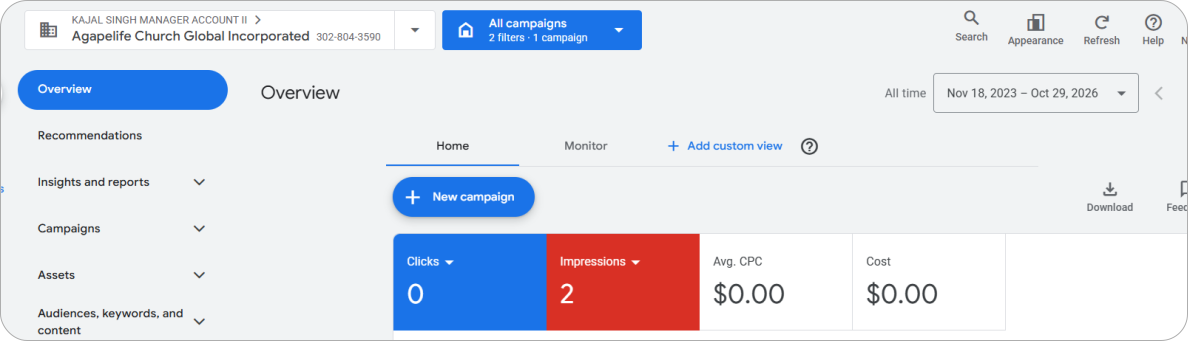
That can include preparing the organisation for Google Ad Grants, setting up reliable conversion tracking, improving donation journeys, building campaign-specific landing pages and measuring which programmes and messages generate meaningful engagement.
The approval project solved the first problem:
Can Google clearly understand and trust this organisation through its website?
Now the focus can shift to the next one:
How can that trust and visibility translate into sustained support for the mission?